


Construction sites, manufacturing plants, and processing facilities all share one common activity: at some point, they’re all tasked with safely lowering or lifting heavy loads. And in environments where costly, high impact lifting equipment like cranes or forklifts wouldn’t be the most effective means at a business’s disposal, old school chain hoists are the perfect solution.
Manual chain hoists and blocks deliver continuous, heavy duty lifting capacity without consuming large amounts of space or resources, or obligating businesses to commit to complex hoisting solutions that require licensed operators. Simplicity means safety, and gear-driven chain hoists are time-tested examples of safe, efficient hoisting.
Manual Chain Blocks Are the Safe Solution For Heavy Lifting
Let’s be honest: in an business climate where mechanisation and automation are increasingly regarded as the means to safety and efficiency, turning to simplicity to achieve the same results can be interpreted as running against the grain. Nothing could be further from the truth though, as manual chain blocks and hoists are equally capable of performing safe and efficient lifts, while also keeping acquisition, deployment, and ongoing maintenance costs at a minimum.
At their most basic, ADR1418-approved and certified chain hoists are little more than pulley systems consisting of a case of variable-sized gears, separate load and pulley chains, and a safety catch. It’s their strict function, however, that makes them so effective. Loads are raised or lowered only by drawing the pulley chain, and are held solidly in position by a locking rachet. That makes these simple block-and-tackle type pulley systems the ideal choice to safely satisfy a range of lifting qualifications that include:
- Hoisting capacities/SWL (safe working loads) to 10 tonnes, with height of lifts (HOLs) up to 6 metres;
- Maximum suspended chain and block weights of only 83kg; and,
- Headroom heights to 850mm, allowing safe overhead clearance at maximum lift.
Critically, the needle and roller bearing pulley assemblies in modern chain block hoists allow employees to achieve maximum mechanical efficiency with only minimal effort. This dramatically reduces the risk of spinal or musculoskeletal injury due to pulling or twisting, while ratchet-style mechanical braking all but eliminates the possibility of the hoist failing or the load accidentally falling.
Trust Heavy Duty Gears and Gear Cases to Take Chain Blocks to the Limit
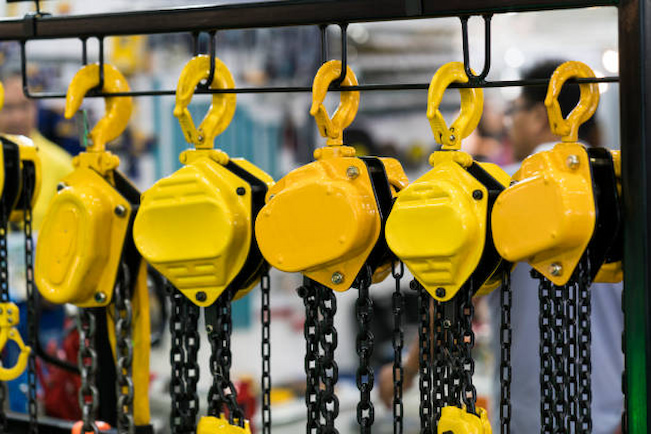
Leverage and force multiplication are the factors that enable chain block hoists to function so effortlessly. They allow gear and sprocket arrangements to amplify short chain pulling distances into significant lifting force. And it’s their hardened durability and natural simplicity that allows chain blocks to actually withstand four to five times their rated working load limit (WLL).
Gear cases invariably have to be as durable as the gears are, and high quality chain blocks for sale also feature an array of strengthened features that include:
- Tempered, shock resistant gear cases and covers;
- Double enclosed assemblies to prevent dust and moisture entry; and,
- Double pawl springs for maximum reliability.
Unshakable reliability highlights why so many businesses and industries prefer to buy chain blocks over automated lifts. They can be use both indoors and outdoors, and aren’t restricted by temperature or other environmental extremes – all qualities that make them perfect for mining and quarrying operations, as well as wrecking and laydown yards.
Businesses are also inclined to buy chain block hoists because of the flexibility that manual lift systems have to offer. They don’t need external power sources, nor do they require the rigid monitoring and maintenance of hydraulic or pneumatic hoists. They still require periodic testing and inspections for optimal safety, though. And as the full weight of a load is borne a manual hoist’s chains, their inspection and general care are especially important.
Making Regular Chain Inspections the Key to Chain Block Safety
The unrivalled simplicity, and straightforward rigging and deployment of manual chain blocks and hoists mean timely inspections are eminently important for safety. And this is especially true in environments where overloading, or prolonged exposure to dust and moisture can potentially lead to employee injuries and costly equipment damage.
Periodic inspections in accordance with manufacturer and business safety guidelines are the key to ensuring chain blocks are in good working order, with pulley and load chain inspections making up the most critical aspect of their testing. The consequences of a hoist chain failure can be catastrophic, which is why along with regular inspections and certification, employees who operate hoists need to be on the lookout for the following at all times:
- Chain links that in any way appear to have become twisted or bent due to shock loading or interference;
- Chain links that have become elongated or stretched as a result of severe hoist overloading;
- Chain links that are showing signs of wear, or abrasion or scoring, possibly due to improper hoist usage;
- Any surface rust or corrosion that could indicate a lack of lubrication; and,
- Chain links that have become tarnished or discoloured due to excessive heat buildup.
Each of these conditions is inherently unsafe and could result in a potentially fatal accident. And any time a chain is found to be deficient after inspection, it needs to be replaced immediately with a new AS2321-compliant chain that’s approved specifically for heavy lifting purposes.
The Final Word
At the end of the day, with businesses and industries that do a lot of heavy lifting, there’s the importance of balancing core workplace safety with the cost of keeping the workplace efficient. These aren’t mutually exclusive requirements. In fact they fully underline the value of simplicity as a means of efficiency.
With their wide range of lifting loads and lift heights, manual chain hoists and blocks are the right choice for businesses that need cost effective hoisting capacity that’s safe and efficient. They’re proof that the flexibility of manual equipment can still be invaluable in modern industrial environments.